Top 10 Non-Owner SR22 Insurance Providers

best sr22 insurance options

When it comes to finding non-owner SR-22 insurance, it's crucial to evaluate your options carefully. Various providers offer competitive rates and solid coverage, but not all are created equal. Understanding the strengths and weaknesses of each can greatly impact your financial and legal standing. From Erie Insurance's affordable plans to Nationwide's robust ratings, the landscape is diverse. So, which providers should you consider for the best overall value?

Key Takeaways

  • Erie Insurance offers non-owner SR-22 policies starting at $35 per month with an A+ rating from A.M. Best, ensuring financial stability.
  • Geico provides competitive pricing from around $40 and simplifies the SR-22 filing process with electronic submissions.
  • State Farm's non-owner SR-22 insurance starts at $45 per month, featuring responsive customer service and flexible payment options.
  • Nationwide has premiums beginning at $75 per month and maintains an A+ rating for strong financial reliability.
  • Auto-Owners Insurance requires working through independent agents and offers extensive auto coverages, though discounts for non-owner SR-22 may be limited.

Erie Insurance

insurance provider based in erie

Erie Insurance stands out in the domain of non-owner SR-22 insurance, offering competitive rates and robust financial backing. With policies starting at just $35 per month, you'll find affordability without compromising on reliability. Rated A+ by A.M. Best, Erie guarantees solid financial stability, which is essential for your peace of mind. While you can access various discounts, such as multi-policy and safety equipment discounts, be aware that customization options are limited compared to other providers. Additionally, you might experience some delays with their online services. SR-22 insurance is often required for drivers who have committed certain violations, making it crucial to understand your needs. Furthermore, Erie provides additional coverage options like emergency road service to enhance your protection while on the road. Overall, Erie provides a strong balance of cost-effectiveness and financial strength, making it a solid choice for non-owner SR-22 insurance.

Geico

When it comes to securing non-owner SR-22 insurance, Geico presents a strong option for drivers in need of reliable coverage. Here are some key points to evaluate:

  1. Availability: Geico offers both SR-22 and non-owner SR-22 insurance, catering specifically to high-risk drivers.
  2. Coverage Types: Their non-owner policies provide liability coverage that meets state minimum requirements.
  3. Filing Process: Geico simplifies the process by electronically filing SR-22 certificates with state DMVs.
  4. Competitive Pricing: Monthly rates start at about $40, making Geico's pricing competitive among providers.

With a solid reputation and a focus on compliance with state regulations, Geico stands out as a practical choice for those needing non-owner SR-22 insurance.

Auto-Owners

Although Auto-Owners Insurance is well-regarded for its extensive range of insurance products, obtaining non-owner SR-22 insurance through them may not be straightforward.

While Auto-Owners excels in various auto insurance coverages, such as collision and liability, their direct offerings for non-owner SR-22 insurance appear limited. You'll likely need to work through independent agents to explore your options, as they manage policy sales.

Although Auto-Owners maintains excellent financial ratings and customer satisfaction, they may not specifically cater to high-risk drivers needing a non-owner SR-22.

If you're seeking this type of coverage, you might find more flexibility and competitive rates with other providers in the market.

State Farm

insurance provider and services

State Farm stands out as a viable option for those in need of non-owner SR-22 insurance, offering a range of features and benefits that cater to high-risk drivers. Here are some key points to contemplate:

  1. Reliable SR-22 Filings: Their deep financial resources guarantee timely filings.
  2. Flexible Payment Options: You can choose a plan that fits your budget.
  3. National Coverage: Policies are available across the country.
  4. Well-Regarded Customer Service: Their support team is recognized for its responsiveness.

While non-owner SR-22 insurance starts at $45 per month, rates may increase based on risk factors.

Although generally more expensive than competitors, State Farm's efficient processes and competitive options make it a solid choice for many drivers.

Nationwide

Nationwide emerges as a strong contender for non-owner SR-22 insurance, particularly appealing to high-risk drivers seeking reliable coverage. With an A+ rating from A.M. Best, Nationwide demonstrates strong financial stability.

Nationwide is a top choice for non-owner SR-22 insurance, offering reliable coverage for high-risk drivers.

Its non-owner SR-22 policies are available nationwide, ensuring broad access for customers. While premiums start at $75 per month, which may be higher than some competitors, the service remains dependable, with a solid reputation for customer support.

Coverage options include basic liability, extensive, collision, and uninsured/underinsured motorist protection. Although it offers fewer specific discounts for non-owner SR-22 plans, Nationwide compensates with personalized policy customization and efficient SR-22 filing.

Its mobile app enhances customer experience, allowing easy management of accounts and claims.

Liberty Mutual

Liberty Mutual stands out as a viable option for non-owner SR-22 insurance, particularly for those seeking flexibility in their coverage. Here are key points to evaluate:

  1. Cost: Non-owner SR-22 policies start at $80 per month, with annual fees ranging from $0 to $200.
  2. Customization: Liberty Mutual allows you to tailor your policy, providing more options than some competitors.
  3. National Coverage: Their policies are available across the country, ensuring accessibility.
  4. Customer Support: Known for strong customer service, they offer reliable support when you need it.

While rates may be higher than some competitors, the combination of flexible discounts and national presence makes Liberty Mutual a solid choice for non-owner SR-22 insurance.

Progressive
forward thinking social change

Progressive offers an extensive solution for those seeking non-owner SR-22 insurance, catering specifically to individuals who need to demonstrate financial responsibility without owning a vehicle. Their non-owner SR-22 policies meet state minimum liability requirements, making it a viable option for high-risk drivers.

The filing process is streamlined, with Progressive providing same-day electronic filing for quick state notification. While the SR-22 filing fee is typically $25, you may notice an increase in premiums due to your high-risk status. However, Progressive remains competitive in pricing compared to other providers.

Additionally, they offer robust customer support to assist with policy management and SR-22 removal, ensuring you stay compliant throughout your filing period.

Farmers

Farmers offers a robust array of options for non-owner SR-22 insurance, making it a solid choice for individuals needing to comply with state requirements without owning a vehicle. Here are some key features to evaluate:

  1. Policy Options: A variety of non-owner policies are available.
  2. Financial Strength: Farmers holds an A rating from A.M. Best, ensuring reliability.
  3. SR-22 Filing Process: The filing process is efficient and straightforward.
  4. Pricing: Monthly rates start around $60, though they may be higher compared to competitors.

While Farmers excels in customer service and financial backing, its online management tools are less sophisticated.

Farmers shines in customer service and financial strength, but its online management tools could use improvement.

Additionally, fewer discount options exist, which may impact overall affordability.

Travelers

Although maneuvering through the complexities of SR22 insurance can be intimidating, Travelers Insurance stands out as a reliable option for individuals in need of non-owner policies.

They provide extensive support, making certain you comply with state requirements while simplifying the application process. Travelers offers competitive rates and flexible coverage options tailored to your specific needs, including liability and collision insurance.

Their non-owner policies are particularly beneficial for those without a vehicle, covering essential financial responsibilities. With a focus on customer satisfaction, Travelers provides dedicated support and educational resources to help you understand your coverage.

This ongoing guidance guarantees you navigate your SR22 obligations effectively, making them a strong contender among non-owner SR22 insurance providers.

American Family Insurance

When exploring non-owner SR22 insurance options, American Family Insurance emerges as a strong contender alongside providers like Travelers. They offer a variety of insurance products, ensuring you find thorough coverage suited to your needs.

Key benefits include:

  1. Diverse Offerings: From auto to life insurance, they've a wide range of options.
  2. High Customer Satisfaction: Their positive reviews reflect strong customer support and service.
  3. Discount Opportunities: You can save up to 25% by bundling policies or benefit from usage-based discounts.
  4. Robust Digital Tools: Their well-rated mobile app simplifies managing your policy and filing claims.

With a solid regional presence and trusted financial stability, American Family Insurance could be a fitting choice for your SR22 needs.

Conclusion

In summary, choosing the right non-owner SR-22 insurance provider can feel like finding a needle in a haystack, but it's vital for your peace of mind. With competitive rates and quality customer support from companies like Erie, Geico, and State Farm, you're bound to find a plan that fits your needs. By comparing options and weighing their benefits, you can make an informed decision that keeps you covered without breaking the bank. Don't underestimate the importance of this choice!

7 Best Ways to Compare SR22 Insurance Rates

comparing sr22 insurance rates

When it comes to finding the best SR22 insurance rates, understanding the nuances of your state's requirements is essential. By gathering quotes from several insurers, you can make informed comparisons. Reviewing coverage options and looking for discounts can greatly impact your overall cost. However, evaluating the reputation of providers and your personal risk profile may also play an important role in your decision-making process. So, what's the next step you should take?

Key Takeaways

  • Utilize online comparison platforms like Compare.com and CheapInsurance.com for side-by-side SR22 insurance quotes from multiple insurers.
  • Visit insurance company websites, such as State Farm and Progressive, to obtain direct quotes reflecting your state's requirements.
  • Consult independent insurance agents who can streamline the process of gathering and comparing SR22 insurance options.
  • Ensure all quotes include the same coverage levels and accurately reflect state-specific minimum liability requirements.
  • Check for available discounts, such as multi-policy bundles or safe driving programs, to lower your overall SR22 insurance costs.

Understand Your State's SR22 Requirements

sr22 insurance state regulations

Understanding your state's SR22 requirements is essential, especially if you're classified as a high-risk driver. SR22 serves as a certificate confirming your minimum liability insurance coverage, mandated after offenses like DUI or reckless driving. Each state has its specific requirements; for instance, California necessitates minimum coverage of $15,000 for bodily injury and $5,000 for property damage, while Texas requires $30,000 and $25,000 respectively. SR-22 insurance is typically filed by the insurance company on behalf of the driver, ensuring compliance with state laws. Additionally, understanding your state's unique SR22 insurance regulations can help you navigate the process more effectively.

Knowing your state's SR22 requirements is crucial for high-risk drivers to ensure compliance and maintain necessary insurance coverage.

Typically, the filing fee is low, around $25, but SR22 insurance can be substantially more expensive than standard policies. Verify you remain compliant by maintaining continuous coverage for the mandated period. Failure to do so may result in a license suspension, complicating your efforts to regain driving privileges.

Gather Quotes From Multiple Insurers

Gathering quotes from multiple insurers is an essential step in securing the best SR22 insurance rates.

Start by utilizing online platforms like Compare.com or CheapInsurance.com to view various quotes side-by-side. You can also visit insurers' websites, such as State Farm and Progressive, where you can access their quote tools directly.

Independent insurance agents can further assist by collecting quotes and guiding you through your options.

When comparing quotes, confirm you're looking at the same coverage levels and consider factors like deductibles, available discounts, and overall costs.

Keep in mind that some insurers mightn't offer SR22 in your state, so research thoroughly to find the best fit for your needs.

Evaluate Coverage Options and Limits

When evaluating SR22 insurance, it's vital to analyze your coverage options and limits, as these factors greatly impact both your protection on the road and your overall premium costs.

Start by understanding your state's minimum liability requirements, which differ markedly; for example, Florida mandates specific personal injury protection and property damage liability.

Next, consider whether to add broad or collision coverage, as these options enhance your policy but can elevate your premiums.

Also, be mindful of the duration for which coverage is required—typically three years—and confirm it remains active to avoid complications.

Evaluating non-owner policies is important if you don't own a vehicle, providing necessary liability without the added costs of broad or collision coverage.

Check for Available Discounts

look for discounts available

Exploring available discounts can greatly lower your SR22 insurance rates, making it essential to identify which ones apply to you.

Many providers offer multi-policy discounts, allowing you to save markedly by bundling car and home insurance. Completing a defensive driving course can also lead to reduced rates, showcasing your commitment to safe driving.

Programs like State Farm's Drive Safe & Save reward safe driving behaviors with additional discounts. Furthermore, opting for electronic billing and auto-pay can further decrease premiums.

If you're a student with good grades or in the military, you might qualify for specific discounts as well. Evaluating these options can lead to substantial savings, so it's worth doing your research.

Assess Provider Reputation and Customer Service

Evaluating provider reputation and customer service is essential for finding the right SR22 insurance. Start by checking financial stability ratings from sources like AM Best, ensuring the provider can cover claims.

Look for customer service reviews on platforms like BBB or Yelp to gauge satisfaction levels. Assess the claims handling efficiency by examining the claims settlement ratio, which indicates how quickly claims are resolved.

Consider the provider's industry reputation and their longevity in the market, as experience often correlates with reliability. Additionally, evaluate support channels for availability and response time, and check if they offer specialized SR-22 support.

Online tools and educational resources can also enhance your experience and understanding of SR-22 requirements.

Consider Your Driving History and Risk Profile

How does your driving history influence your SR22 insurance rates? Your past actions behind the wheel play an essential role in determining your premiums.

Your driving history significantly impacts your SR22 insurance rates, shaping your premiums based on past actions behind the wheel.

For instance, a DUI can spike your rates by 85% to 92%, while even a minor at-fault accident can raise them by approximately 43%. Additionally, traffic violations can lead to rate increases of up to 21%.

States often use point systems to track violations, which can affect your insurance and potentially result in license suspension. Your risk profile also includes your vehicle type, location, and coverage levels.

Understanding these factors allows you to obtain more accurate quotes and make informed decisions about your SR22 insurance.

Review and Adjust Your Policy Regularly

regularly review and adjust

Your driving history greatly impacts your SR22 insurance rates, but it's equally important to regularly review and adjust your policy to make sure it meets your current needs.

Start by validating that you meet your state's minimum liability coverage requirements, as these can change. Keep an eye on your policy expiration dates and guarantee timely premium payments to avoid lapses.

Communicate regularly with your insurer about any changes in your circumstances, like vehicle ownership or deductible adjustments. Additionally, gather quotes from multiple providers to compare rates and potential discounts.

Assess your coverage needs periodically, especially if your circumstances change, to make sure you aren't overpaying for unnecessary coverage while maintaining compliance with SR22 regulations.

Conclusion

In your quest for the best SR22 insurance rates, remember that overlooking even the tiniest detail could cost you a fortune. With the right approach, you can uncover savings that feel like winning the lottery, all while securing the coverage you need. By diligently comparing quotes, evaluating options, and staying informed about your provider's reputation, you're not just choosing insurance; you're crafting a financial safety net that's as essential as air. Don't settle—your wallet deserves the best!

5 Tips on California SR22 Insurance Penalties

california sr22 insurance penalties

Steering through the intricacies of California SR22 insurance can feel like walking a tightrope. While it's a necessary step for those with certain driving offenses, the penalties for lapses can be severe. You'll want to stay informed on how maintaining coverage affects your license, your insurance rates, and your overall financial well-being. Understanding these aspects is essential, especially when it comes to managing costs and compliance effectively. What should you prioritize to avoid trouble?

Key Takeaways

  • Maintain continuous SR22 coverage to avoid suspension of your driver's license and additional fines.
  • Be aware that lapses in SR22 coverage can lead to vehicle impoundment and financial strain.
  • Understand that non-compliance with SR22 requirements may result in court appearances and extended probation.
  • Expect insurance premiums to increase significantly due to being categorized as a high-risk driver after violations.
  • Regularly monitor your SR22 status and keep copies of your SR22 certificate to prevent lapses.

Understanding the Necessity of SR22 Insurance in California

sr22 insurance requirement explained

While you may not have anticipated needing it, SR22 insurance is an important requirement in California for drivers who've faced serious traffic violations. This certification proves you've met the state's minimum liability insurance requirements, helping to reinstate your suspended license. Courts or the DMV typically mandate SR22 after serious offenses like DUIs, uninsured accidents, or multiple violations within a short span. By obtaining SR22, you demonstrate financial responsibility, a significant step to regaining your driving privileges. Maintaining continuous coverage is essential during this SR22 filing period, as any lapse could lead to further penalties. Additionally, it's important to note that SR22 insurance can often result in higher premiums, reflecting the increased risk perceived by insurance providers.

Consequences of Failing to Maintain SR22 Coverage

Failing to maintain your SR22 coverage can lead to serious and immediate consequences that jeopardize your driving privileges.

First, a lapse can result in the suspension of your driver's license, along with potential fines for violating DMV regulations. You might also face vehicle impoundment, adding to your financial burden.

A lapse in your SR22 coverage can lead to license suspension and hefty fines, compounding your financial strain.

If your coverage lapses, you may need to restart the SR22 period, incurring additional filing fees. Additionally, non-compliance could lead to court appearances, extended probationary terms, or even jail time for severe violations.

The California DMV is promptly notified of any lapse, escalating administrative fines and increasing your insurance rates.

Impact of SR22 on Insurance Premiums

The requirement for SR22 insurance greatly impacts your premiums, primarily because insurers categorize you as a high-risk driver. This perception often leads to significant premium increases, ranging from 20% to 60%, depending on the nature of your violation and driving history.

Serious offenses, like DUIs, tend to trigger the largest hikes. Your options for insurance may also be limited, as not all providers offer SR22 filings, which can further elevate costs.

While the SR22 filing fee is a one-time expense, the ongoing premium increases can overshadow this initial cost. Even after the SR22 requirement ends, past violations continue to influence your rates, making it essential to shop around for the best coverage options.

Steps to File and Maintain SR22 Insurance

filing and maintaining sr22

Filing and maintaining SR22 insurance in California involves several important steps that guarantee compliance with state regulations.

First, choose an insurance provider that handles SR22 filings, as not all companies offer this service. Next, gather the necessary documentation, including your driver's license and relevant court documents.

Your insurer will then electronically file the SR22 with the DMV, usually for a fee between $15 and $25. To maintain your SR22, make certain of continuous coverage to avoid penalties, and renew your policy at least 15 days before expiration.

Monitor your SR22 status for any changes, and keep copies of your SR22 certificate for personal records. Remember, even if you move, California's SR22 obligations remain in effect.

Exploring Cost-Effective SR22 Insurance Options

Maintaining SR22 insurance doesn't have to break the bank, especially when you explore cost-effective options available in California.

Start by shopping around; comparing rates from various providers like Mercury, Geico, and Progressive can lead to significant savings.

Comparing rates from providers like Mercury, Geico, and Progressive can lead to substantial savings on your SR22 insurance.

Consider opting for non-owner SR22 insurance if you don't own a vehicle, as it typically costs less. Raising deductibles can lower your monthly premiums but be prepared for higher out-of-pocket expenses if you file a claim.

Additionally, taking defensive driving courses may offer discounts and help improve your driving record. Bundling insurance policies can also provide savings.

Finally, look into usage-based programs that reward safe driving habits with lower premiums.

Conclusion

In conclusion, maneuvering SR22 insurance in California requires diligence and awareness. While you might worry that maintaining continuous coverage will strain your budget, remember that avoiding penalties and higher premiums makes it worthwhile. Choosing the right insurer and keeping track of your status can save you money in the long run. By following these tips, you not only comply with legal requirements but also enhance your driving record and insurance affordability. Stay proactive to protect your financial interests.

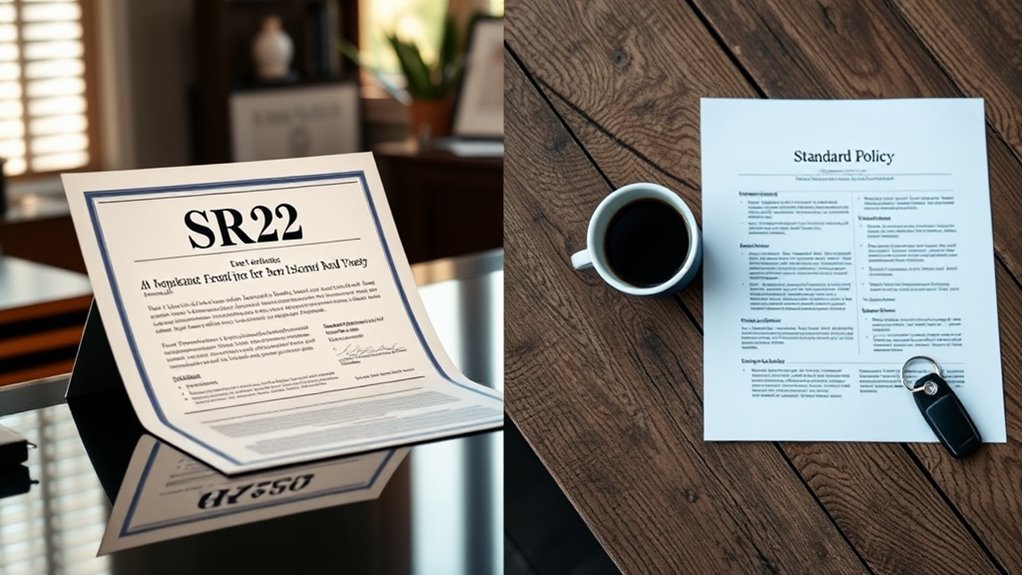
5 Key Differences: SR22 Vs Standard Insurance

sr22 insurance comparison differences

Steering through the nuances of SR-22 and standard insurance can feel like a complex puzzle. While SR-22 serves a specific purpose for high-risk drivers, standard insurance offers a more traditional safety net. Understanding their distinct requirements and implications can greatly impact your choices. As you consider these differences, you'll uncover factors that could influence your coverage and costs in ways you might not expect. What might those factors be?

Key Takeaways

  • SR-22 is a form for high-risk drivers, while standard insurance is available to all drivers without major violations.
  • SR-22 requires continuous coverage reporting to the DMV, whereas standard insurance has less oversight.
  • Premiums for SR-22 typically range from $2,000 to $5,600 annually, reflecting the high-risk classification.
  • Lapses in SR-22 can lead to immediate legal penalties, unlike standard insurance lapses that only result in being uninsured.
  • SR-22 filings confirm minimum liability coverage but are not insurance policies themselves, unlike standard insurance.

Purpose and Definition of SR-22 Vs Standard Insurance

sr 22 insurance requirements explained

When considering auto insurance options, understanding the purpose and definition of SR-22 and standard insurance is essential.

An SR-22 serves as proof that you meet your state's minimum auto liability insurance requirements, specifically for high-risk drivers. It's not an insurance policy but a form filed by your insurer, ensuring continuous coverage for drivers with serious offenses like DUIs. This certificate of financial responsibility is required to validate that a driver is maintaining their insurance coverage. In California, an SR-22 is typically required for certain serious offenses that can affect a driver's ability to obtain standard insurance.

In contrast, standard insurance offers broader coverage, including liability, bodily injury, and property damage, and is accessible to all drivers without high-risk conditions.

While SR-22 is mandated by most states for certain individuals, standard insurance policies don't require specific filings, providing flexibility and often lower premiums for the general driving population.

Understanding these distinctions helps in making informed insurance choices.

Required Coverage Differences

Although both SR-22 and standard insurance provide essential coverage for drivers, significant differences exist in their required coverage and regulatory frameworks.

SR-22 policies demand continuous coverage reporting to the DMV, which isn't required for standard policies. A lapse in SR-22 can lead to immediate legal penalties, while standard coverage merely results in being uninsured.

SR-22 requires ongoing DMV coverage reporting, unlike standard policies, where lapses only result in being uninsured.

Additionally, SR-22 is typically mandated for high-risk drivers following serious violations, ensuring the state monitors compliance closely. In contrast, standard insurance has minimal oversight unless associated with major incidents.

Both types offer liability, collision, and extensive coverage options, but SR-22's stringent requirements reflect its purpose of maintaining coverage for high-risk individuals, establishing a clear distinction in regulatory demands.

Cost and Premium Comparisons

The differences in insurance coverage directly influence the costs associated with SR-22 policies compared to standard insurance. SR-22 premiums typically range from $2,000 to $5,600 annually, considerably higher than standard rates due to the high-risk classification.

Filing fees for SR-22 can add an extra $15 to $50, with some states imposing additional fees for reinstatement. Monthly rates vary, starting at around $25 for minimum coverage but often exceeding $100 for full coverage.

Non-owner SR-22 policies may offer more affordable options. Regional variability is notable, with states like Wisconsin averaging about $1,643 annually.

Additionally, different insurance providers present varying rates, making comparison shopping essential for cost management.

Risk Classification for Drivers

driver risk assessment criteria

Understanding risk classification for drivers is essential, especially when it comes to insurance policies such as SR-22 and standard coverage.

SR-22 typically applies to high-risk drivers, often due to severe infractions like DUIs or repeated traffic offenses. In contrast, standard insurance caters to a broader audience, offering coverage to those without significant driving violations.

This classification affects your premiums; SR-22 drivers usually face higher rates due to their elevated risk status. States mandate SR-22 filings to guarantee that high-risk drivers maintain minimum liability insurance, impacting your ability to reinstate driving privileges.

Ultimately, understanding these classifications can help you navigate your insurance options and find the most suitable coverage for your driving history.

Policy Administration and Reporting Requirements

Maneuvering through the complexities of insurance policies requires familiarity with both policy administration and the reporting requirements associated with SR-22 filings. Understanding these elements is vital, especially for high-risk drivers.

  1. Timely SR22 filings can prevent license suspension.
  2. Continuous coverage guarantees compliance and avoids penalties.
  3. Automated reporting enhances transparency and efficiency.

SR22 forms aren't insurance policies but essential documents confirming minimum liability coverage. Insurers must file these forms promptly, alerting the DMV of any policy lapses.

States have specific regulations regarding SR22 duration and the offenses that trigger its necessity. With automated filing and daily processing, insurers provide real-time updates on compliance status, emphasizing the importance of maintaining continuous coverage to avoid serious consequences.

Conclusion

In conclusion, understanding the distinctions between SR-22 and standard insurance is vital for any driver, particularly if you've faced serious offenses. While SR-22 guarantees compliance and accountability, its costs can be a shock. But what happens if you let your coverage lapse? The consequences can be severe. As you navigate these options, consider your driving history and future needs—because the choices you make now could have lasting impacts on your insurance journey. Are you prepared?

3 Tips for Affordable SR22 Insurance Costs

affordable sr22 insurance tips

Steering through the world of SR-22 insurance can feel like wading through a dense fog. However, with the right strategies, you can find affordable options that fit your needs. By comparing quotes, exploring discounts, and maintaining a clean driving record, you can greatly reduce your costs. Want to know how these tips can make a difference in your insurance premiums?

Key Takeaways

  • Compare quotes from multiple providers using platforms like SR-22Savings.com and CheapInsurance.com to find the best rates.
  • Look for available discounts such as bundling SR-22 with home or renters insurance and safe driving program incentives.
  • Maintain a clean driving record by avoiding violations and enrolling in defensive driving courses to lower premiums.
  • Ensure continuous car insurance coverage to avoid gaps that lead to higher premiums or penalties.
  • Regularly review your insurance needs and payment history to manage costs effectively and build a positive insurance profile.

Compare Quotes From Multiple Providers

evaluate multiple provider quotes

When it comes to finding affordable SR-22 insurance, comparing quotes from multiple providers can save you significant money. Platforms like SR-22Savings.com streamline the process, letting you obtain various quotes quickly. CheapInsurance.com offers tools to help you compare coverage levels and prices, ensuring you choose the right fit for your needs. It's important to understand that SR-22 insurance is a certificate of financial responsibility required by the state of California for high-risk drivers. MoneyGeek and LendingTree also allow you to browse rates across providers, revealing potential discounts and saving you time. Remember that maintaining continuous car insurance is essential for the validity of your SR-22, so factor that into your comparisons.

Consider Available Discounts

While searching for affordable SR-22 insurance, it's important to take into account the various discounts available to you. These can greatly reduce your costs and make your insurance more budget-friendly.

Consider these options:

  1. Bundling Discounts: Combine your SR-22 insurance with home or renters insurance for a better rate.
  2. Safe Driving Programs: Use apps that track your driving habits; good behavior can lead to discounts.
  3. Defensive Driving Courses: Complete an approved course, especially if mandated by the court, to lower your premiums.

Don't forget to ask your insurer about electronic billing discounts and any high-risk driver programs they might offer.

Taking advantage of these discounts can lead to considerable savings on your SR-22 insurance.

Improve and Maintain a Clean Driving Record

To guarantee you maintain a clean driving record, it's crucial to adopt safe driving habits and comply with traffic laws.

Avoiding traffic violations is key; each infraction can lead to complications, including potential SR22 requirements. Consider enrolling in defensive driving courses, which can enhance your skills and may lower points on your record.

Always address legal issues promptly to mitigate the need for SR22 filings. Regular vehicle maintenance guarantees your car is safe to operate, while planning your routes can help you avoid stressful situations.

Finally, minimize distractions while driving—texting or eating can increase your risk of accidents. By consistently practicing these habits, you can keep your record clean and eventually lower your insurance premiums.

Conclusion

In the quest for affordable SR-22 insurance, remember that a little effort goes a long way. By comparing quotes, taking advantage of discounts, and keeping your driving record clean, you can greatly cut costs. Think of it as planting seeds for future savings; the more you nurture your driving habits today, the more your premiums will blossom into savings tomorrow. So, take charge and watch your wallet grow!

Why Is the SR22 Insurance Period Important?

sr22 insurance duration significance

Imagine steering through a stormy sea without a life jacket; that's what driving without SR22 insurance feels like after a serious violation. This insurance serves as your lifeline, proving you're financially responsible during a critical period of one to three years. If you lose that coverage, your license could be at risk, and penalties could pile up. So, why is maintaining that coverage essential for your future on the road?

When it comes to maintaining your driving privileges after a serious traffic violation, understanding the importance of the SR22 insurance period is imperative. The SR22 form acts as proof that you have the minimum liability insurance required by your state, demonstrating your financial responsibility on the road. This period typically lasts between one to three years, contingent upon the severity of your violation and the regulations of your state. Failing to maintain continuous coverage throughout this period could lead to a suspension of your driving privileges, which can have serious consequences for your daily life.

Understanding the SR22 insurance period is crucial for maintaining your driving privileges after a serious traffic violation.

During the SR22 insurance period, the need for uninterrupted coverage can't be overstated. If your policy lapses, even for a moment, your insurer is required to notify the DMV, which could trigger a new suspension of your license. This makes it critical for you to stay on top of your insurance policy and promptly renew or update it as needed. Additionally, continuous coverage during this time is essential to avoid penalties that could further complicate your driving situation. Maintaining SR22 insurance is essential not only for compliance but also for regaining trust in your driving capabilities.

Should you decide to switch insurance carriers during this time, the new provider must also file a new SR22 form to guarantee compliance with state requirements. The clock for the SR22 period typically begins after any administrative suspensions have concluded, emphasizing the necessity for continuous coverage right from that point.

Understanding the various reasons that might lead to needing an SR22 can help you stay vigilant. Common triggers include DUIs, driving without insurance, and reckless driving. Each of these offenses carries its own implications, and the severity will often dictate the duration of the SR22 requirement. Some states may impose longer periods for repeated offenses, so maintaining a clean driving record during your SR22 period is crucial.

Moreover, the financial implications of SR22 insurance are significant. Because drivers requiring SR22 are classified as high-risk, you can expect to pay more for your insurance premiums compared to standard policies. To mitigate these costs, consider comparing quotes from different insurers or completing a defensive driving course, which may qualify you for discounts.

Keep in mind that moving to a new state doesn't absolve you from your SR22 obligations. If you relocate, you'll still need to fulfill the requirements laid out by your previous state. Each state has its own rules regarding SR22 insurance, including varying coverage limits and durations, so it's important to research and comply with these regulations to avoid complications.

Conclusion

In the journey of life, the SR22 insurance period is your guiding star, illuminating the path to responsible driving. Just as a ship must navigate through storms, you must maintain uninterrupted coverage to avoid the turbulent waters of license suspension and penalties. By honoring this obligation, you not only safeguard your driving privileges but also showcase your commitment to accountability. Embrace this period as an opportunity to steer clear of past mistakes and chart a course toward a brighter, safer future.

Why Do SR22 Insurance Costs Vary in California?

sr22 insurance cost factors

SR22 insurance costs in California can seem as unpredictable as the weather. Several factors influence these rates, from your driving history to the severity of your infractions. The location where you live can also markedly impact your premiums. With each insurance provider using different pricing models, understanding these variables becomes essential for finding the best deal. What specific elements should you consider to navigate this complex landscape effectively?

When you need SR-22 insurance in California, understanding the costs involved is vital, especially since they can vary widely based on your specific circumstances. The average annual cost of SR-22 insurance in California is approximately $2,403, but this figure isn't set in stone. It fluctuates considerably depending on several factors, including the nature of your driving violations, your insurance provider, and your driving history.

The type of violation you've committed plays an essential role in determining your SR-22 insurance costs. For instance, if you've been convicted of a DUI, expect a substantial increase in your premiums—often up to 166%. DUIs typically lead to the highest rates, while other infractions, like reckless driving, can also result in increased costs but may not be as steep. It's significant to acknowledge that these violations will impact your insurance rates for up to ten years, meaning you'll likely pay higher premiums for a considerable period following the infraction. Additionally, California law mandates that drivers must maintain SR-22 for a minimum duration, which can contribute to the overall cost of insurance.

The type of violation significantly affects SR-22 insurance costs, with DUIs causing the highest premium increases.

Your driving history also influences your premiums. If you maintain a clean driving record, you're more likely to secure lower rates. In contrast, a history riddled with infractions can lead to skyrocketing insurance costs. This underscores the necessity of driving responsibly and avoiding violations whenever possible.

Location is another key factor in the variability of SR-22 insurance costs. Different zip codes have distinct accident rates and theft statistics, which can greatly impact your premiums. For instance, urban areas with higher traffic and accident rates tend to have higher insurance costs compared to rural locations. As a result, your area of residence can dictate how much you'll pay for SR-22 insurance.

Additionally, not all insurance providers offer the same rates for SR-22 insurance. Companies like Geico, Mercury, and Progressive have varying pricing structures, which means it's vital to shop around for the best deal. Often, you might find that one insurer offers considerably lower rates for a similar violation compared to another. This variability highlights the necessity of comparing quotes from multiple providers.

You should also consider optional coverages. If you decide to add comprehensive and collision coverage to your SR-22 policy, your costs will inevitably increase. These additional coverages can provide greater protection but come at a price. If you're looking to save money, sticking with the minimum required liability coverage might be a more economical choice.

Lastly, if you don't own a vehicle, non-owner SR-22 insurance can be a more affordable option, averaging around $932 annually. This type of insurance covers liability only and can be perfect for occasional drivers. Understanding these aspects can help you make informed decisions about your SR-22 insurance needs, ensuring you find the most suitable and cost-effective coverage for your situation. Moreover, most drivers must maintain SR-22 for three years to comply with California requirements, which can add to the overall expense of insurance.

Conclusion

In California, SR-22 insurance costs fluctuate like the shifting sands of a desert, shaped by your driving history, the weight of past violations, and the insurer's unique pricing strategies. A DUI can cast a long shadow over your premiums, while your location—whether you're nestled in an urban sprawl or a quiet rural enclave—further influences costs. By meticulously comparing quotes, you can navigate this complex landscape and uncover the most budget-friendly options tailored just for you.

Why Choose Affordable SR22 Insurance in California?

affordable sr22 insurance benefits

When life throws you a curveball, like needing SR-22 insurance in California, finding an affordable option can feel overwhelming. High-risk designations often lead to steep premiums, but you don't have to settle for financial strain. Choosing affordable SR-22 insurance can help you meet state requirements, manage costs, and speed up your license reinstatement. Discovering how to navigate this process effectively could make all the difference in regaining your driving privileges.

If you've found yourself needing SR-22 insurance in California, you're not alone; many drivers face this requirement after serious violations like DUIs. Understanding what SR-22 insurance entails is fundamental. It's not an insurance policy but a certificate proving that you meet the minimum liability coverage mandated by the state. Your insurance provider files this certificate with the California Department of Motor Vehicles (DMV), and you'll need to maintain it for typically three years. Continuous coverage is critical during this period; if you let it lapse, you risk resetting your SR-22 requirement.

Choosing affordable SR-22 insurance can greatly reduce the financial strain of being classified as a high-risk driver. Affordable options exist that allow you to maintain the necessary coverage without overwhelming your budget. Lower premiums can help you comply with state regulations, guaranteeing you don't face additional hardships. By opting for cost-effective policies, you can manage the extra expenses that come with your high-risk designation. Furthermore, affordable SR-22 insurance can speed up your license reinstatement process, getting you back on the road sooner. SR-22 insurance typically requires continuous coverage for up to three years after serious traffic violations.

Several factors influence the cost of SR-22 insurance. Your driving history, location, and the insurance provider you select all play a role in determining your premiums. For instance, if you've had a DUI, you might find that your insurance rates remain elevated even after the SR-22 requirement ends. Also, losing any good driver discounts due to violations can lead to higher premiums.

Insurance companies typically regard SR-22 holders as high-risk, which directly impacts pricing. Don't forget that filing fees for the SR-22 certificate can add another $25 to $40 to your overall costs.

When searching for the cheapest SR-22 insurance in California, it's important to compare different providers. For example, CSAA offers the most affordable minimum coverage at around $40 per month, while National General provides full coverage for about $127 monthly. Farmers has competitive rates for non-owner SR-22 insurance at approximately $62 per month. By comparing quotes, you can find substantial savings, as rates can vary greatly even for the same coverage based on your location and the insurer's policies.

To obtain affordable SR-22 insurance, start by contacting providers that specialize in SR-22 filings. They'll guide you through the process and confirm the certificate is properly submitted to the California DMV. You may need to evaluate payment plans to keep continuous coverage.

Also, look for instant SR-22 filing services that can expedite your license reinstatement. A thorough review of the policy terms is indispensable; knowing what you're getting guarantees you make the best choice for your situation.

Conclusion

In the journey of driving, finding affordable SR-22 insurance in California is like discovering a hidden gem in a vast desert. It not only lightens your financial load but also paves the way for reclaiming your freedom behind the wheel. By exploring your options and comparing rates, you can secure the coverage you need without breaking the bank. Embrace this opportunity to steer towards a brighter, more secure future, and let the open road beckon you once again.

What Are the Myths Surrounding SR22 in California?

sr22 misconceptions in california

When discussing SR22 in California, it's easy to fall prey to several myths that can distort your understanding. Many people mistakenly think SR22 is a type of insurance, or that it can prevent future license suspensions. Others assume it's only for vehicle owners, overlooking non-owner policies. These misconceptions can lead to serious consequences. So, what's the real truth about SR22? Understanding the facts is essential for maneuvering your driving responsibilities effectively.

There are many misconceptions about SR22 in California that can lead to confusion for drivers facing serious traffic violations. One of the most common myths is that SR22 is a type of insurance; however, it's actually a form that demonstrates you have the legally required liability coverage. This document is mandated for those who've committed serious offenses, such as DUIs or reckless driving. Understanding this distinction is essential, as it sets the foundation for understanding your responsibilities and the implications of needing SR22. Additionally, SR22 insurance is often required for a specified period, typically three years, depending on the severity of the offense.

You might think that obtaining an SR22 is a straightforward task, but it's important to recognize that not all insurance providers offer this service. When you decide to file for an SR22, your insurance company must submit the form to the state on your behalf. This means you need to shop around and confirm that your current provider can assist with your SR22 filing.

Also, be prepared for a filing fee that typically ranges from $15 to $25, a small price compared to the potential costs associated with your driving violations.

One misconception is that filing for SR22 offers protection against future license suspensions. In reality, it doesn't grant you immunity; if you incur further violations, you may face additional penalties, including license suspension.

Additionally, moving to another state doesn't eliminate the requirement for SR22. If you've been mandated to maintain SR22 in California, you'll still need to comply with that requirement, even if you relocate.

Another prevalent myth is that you must own a vehicle to require SR22. This is untrue, as non-owner SR22 policies are available for individuals who primarily drive vehicles they don't own. This flexibility is important for those who may need to fulfill the SR22 requirement without having a personal vehicle.

You should also be aware that filing for SR22 can greatly impact your insurance premiums. Insurers often perceive individuals with SR22 as high risk, leading to increased rates. The severity of your offense plays a key role in determining how much your premiums will rise. SR-22 filing may result in higher premiums if the insurance company views you as a greater risk.

However, it's advisable to shop around for insurance providers, as rates can vary widely.

Lastly, maintaining continuous insurance coverage during the SR22 period is non-negotiable. Any lapses in coverage can lead to penalties, including potential license suspension, so it's critical to stay compliant. Failure to do so can jeopardize your ability to reinstate your license after the SR22 period ends.

In California, the SR22 requirement generally lasts for three years, a period during which you must guarantee your insurance remains active.

Conclusion

To sum it up, don't let these myths about SR22 mislead you into a world of confusion! It's not insurance, it can't shield you from future suspensions, and it's not just for car owners. Understanding these facts can save you from headaches and potential legal troubles. So, arm yourself with the truth and navigate your driving journey with confidence—because ignorance isn't just bliss, it could lead you straight to the DMV's front door!

What Are Insurance Policy Limits for SR22?

sr22 insurance policy limits

Many drivers underestimate the importance of understanding insurance policy limits for SR-22 coverage. These limits dictate how much your insurer will pay for bodily injury and property damage claims after serious driving infractions. Meeting state minimum requirements is just the beginning. You might need to evaluate higher coverage limits for better financial protection. What factors should you weigh when deciding on the right coverage for you?

When you're required to obtain SR-22 insurance, understanding the policy limits is fundamental for guaranteeing adequate financial protection. An SR-22 isn't a type of insurance itself; instead, it's a certificate of financial responsibility that proves you have at least the minimum required auto insurance coverage. Your insurance company files this certificate with the Department of Motor Vehicles (DMV), and it's typically required after serious infractions like a DUI, multiple traffic violations, or driving without insurance.

The policy limits in SR-22 insurance define the maximum amount your insurer will pay for claims arising from an accident. These limits must meet your state's minimum liability coverage requirements, which typically include Bodily Injury (BI) and Property Damage (PD) coverage. Each state sets its own minimums, so you'll need to familiarize yourself with these figures to verify you're compliant. For example, a state might require $25,000 for BI per person, $50,000 per accident, and $20,000 for PD. Additionally, it's crucial to note that each state has unique minimum auto liability insurance requirements, which can affect your coverage needs. Understanding these minimums can help ensure you're adequately insured and compliant with state laws.

Understanding the policy limits for SR-22 insurance is crucial, as they dictate your insurer's maximum payout for accidents.

While these minimum limits are a starting point, higher coverage limits can provide additional protection. Opting for greater coverage might increase your premiums, but it can also greatly reduce your financial risk in the event of an accident. If you're involved in an accident where damages exceed your policy limits, you could be responsible for paying the difference out of pocket, so it makes sense to reflect on your financial situation when selecting coverage.

In addition to standard liability coverage, there are various types of coverage associated with SR-22 insurance. Bodily Injury Liability covers medical expenses for others injured in an accident you caused, while Property Damage Liability covers damages to others' property. Depending on your state, you might also be required to carry Personal Injury Protection (PIP) for additional medical benefits or Uninsured/Underinsured Motorist coverage, which protects you in accidents involving drivers who lack sufficient insurance.

The costs associated with SR-22 insurance are generally higher than standard insurance premiums. The offense that necessitated the SR-22 filing heavily influences the cost, with more severe infractions leading to higher rates. Your driving history, age, and even gender can also impact your premiums. Insurance companies use various risk assessment models, so you'll want to shop around and compare quotes from multiple insurers to find the best deal.

Once you understand the significance of policy limits and the types of coverage available, obtaining SR-22 insurance becomes a more manageable task. You'll want to contact your current insurance provider to file the SR-22 form with the DMV. If they're unwilling, consider other companies that specialize in SR-22 insurance.

Conclusion

In summary, understanding the insurance policy limits for SR-22 coverage is essential for protecting yourself on the road. By knowing the state minimum requirements and considering higher limits, you can guarantee you're not left high and dry in the event of a serious accident. Remember, investing in adequate coverage now can save you from hefty expenses later. So, take the time to evaluate your options and drive with confidence, knowing you're well-protected.